
Shares of rate-sensitive realty, bank and auto sectors were on buyer's radar on Wednesday.

'The rising cost of construction, the cost of doing business, high compliance, and inflation/interest rates going up have already reduced returns to single digits.'
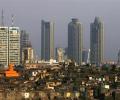
Some of the country's largest listed real estate developers - DLF, Prestige Estates, and Puravankara - are foraying into the Rs 50,000-crore residential property market of Mumbai, where home prices are among the highest in the world. All of them are set to launch residential projects in the financial capital of the country, where the market is dominated by players such as Runwal, Lodha, and Oberoi Realty, among others. Leading the race is Prestige, which has lined up 6 million square feet (msf) of new launches in the city across Mulund and Byculla in the third quarter of this financial year (2021-22).

Although residential sales faced a major set back in Q2, they made a comeback with help of pent up demand.

HDFC Bank was the top loser in the Sensex pack, falling 2.99 per cent, followed by Adani Ports at 2.87 per cent.

On July 31, one of the five shortlisted companies, IRB Infrastructure, had said it would not bid for MTHL.

This is the second extension for the bids since June 18.

Vision 2025 to focus on four clusters; aim is to join the global club of top 25 companies.

Mumbai, India's financial capital, is set for a mega transformation with a massive patch of land opening up for redevelopment; a new metro railway ready to start services by the year-end; and the country's oldest railway station, the Chhatrapati Shivaji Terminus, going for modernisation with private sector participation. Work on Mumbai's second airport will start from next month, while construction of the sea link connecting central Mumbai to Navi Mumbai has already moved into a fast lane despite Covid-induced lockdowns. Also, a coastal road project, connecting Nariman Point to Worli, is under way and will help decongest the city to quite an extent. Of all these mega infrastructure projects, the one that has a huge potential to change the city's skyline is the Eastern Waterfront project - to be built on the Mumbai Port Trust (MbPT) land.

The project cost was pegged at Rs 4,766 crore (Rs 47.66 billion).

BSE Auto was the top sectoral loser with a 4.6% fall followed by realty sector down 3.7% and consumer durables 3.6% post disappointing IIP numbers

Tata's Vistara has a very strong core team to look into daily operations.

Bajaj Finserv was the top gainer in the Sensex pack, soaring around 8 per cent, followed by Tata Steel, Tech Mahindra, Bajaj Finance, HDFC Bank and SBI.

Titan was the top gainer in the Sensex pack, rising over 3 per cent, followed by M&M, Reliance Industries, Axis Bank, TCS, Maruti and Infosys. NSE Nifty surged 122.10 points to 15,885.15.

Shares of rate sensitive sectors such as realty, infrastructure, banking and automobiles ended higher ahead of the Reserve Bank of India (RBI) mid-quarter policy review on June 17.

After years of living with his family in a poky 110 sq. ft. 'house', textile worker Sambhaji Surve dreams of moving into a home four times the size once the Maharashtra government starts its ambitious redevelopment of the 39-acre Kamathipura shanty town in south-central Mumbai. Sharing his dream are about 8,000 other families hoping for a better life when the redevelopment project, part of the government's effort to redevelop old settlements and make life more livable for some residents, gets underway. The Shiv Sena-Nationalist Congress Party aims to redevelop BDD Chawl and Dharavi but for Surve all the matters is Kamathipura where he arrived in the 1970s from Nasik to work in a textile mill. Kamathipura was originally built 150 years ago following construction of a causeway to connect the seven islands of Mumbai. From the British Raj to post-independence, it became infamous for slums and brothels.

The sentiment-driven rally also got support from stock specific earning results and Finance Minister Arun Jaitley's statement that the Centre will step up reforms to attract more investment and fill up infrastructure deficit.

With its new hybrid annuity model, the government is confident of getting more funds from India Inc.

Union ministry of home affairs changed its mind and gave bid clearance for Hiranandani Developers and its consortium partner, Zurich Airport

The airports chosen for operation, management and development through a public-private partnership model are those in Lucknow, Ahmedabad, Jaipur, Mangaluru, Thiruvananthapuram, and Guwahati.

Almost all the big mall developers/investors - such as Raheja-owned Inorbit Malls, Xander-APG joint venture Virtuous Retail South Asia (VRSA), property developer Prestige Estates Projects, and Blackstone-owned Nexus Malls - are looking to double their space in a year or two.

Top losers in the Sensex pack include Bharti Airtel, Infosys, Asian Paints, RIL, Coal India, HDFC Bank, HDFC, TCS, ONGC and M&M, falling up to 3.09 per cent.

Industry watchers attribute a lot of the current successes of the $6 billion Hero Group to how B M Munjal planned and executed succession in HeroCorp, balancing the interests of other family-owned businesses.

Despite the absence of any notable price growth, transaction volumes are picking up in major Indian cities. The surge in sentiments is also backed by a significant rise in transparency in the industry.

One of Mumbai's biggest real estate redevelopment projects of Bombay Development Directorate's (BDD's) chawls (large buildings divided into many separate tenements, offering cheap, basic accommodation) has taken off in Central Mumbai, opening up a Rs 20,000-crore opportunity for real estate companies. It is expected to drive down real estate prices in Central Mumbai by up to 25 per cent, forecast real estate experts. Spread over 92 acres in Central Mumbai's prime localities of Worli, Lower Parel, and Dadar and consisting 195 four-storey houses, the BDD chawls were constructed in the 1920s.

Oil and Natural Gas Corporation, Hindalco Industries, Tata Steel and Vedanta were down up to 70 per cent below their one-year highs.

Ajit Mishra, vice president, Research, Religare Broking, answers your queries.

Investors booked profits in range-bound trade, led by PSU, oil & gas, energy, infrastructure, telecom, realty, healthcare, bankex, FMCG, capital goods and power counters.

Under the hybrid-till model, a portion of non-aeronautical revenue (commercial revenue) at the airport is taken into consideration while fixing the landing and parking charges, user fees and other aeronautical charges.

So which sectors are likely to do well in 2022? Should you focus on domestic economy-related sectors or export-oriented ones?

Sensex firm on favourable GDP numbers for FY16.

GVK Group that runs the swanky MIAL (Mumbai international airport) pipped rival GMR Group to bag the contract for the proposed facility in Navi Mumbai which will ease the severe congestion at the Chhatrapati Shivaji International Airport.

Equity benchmarks erased early gains after realty, capital goods, teck, auto, PSU, IT, power and bankex counters came under selling pressure, falling up to 1.28 per cent.

The NSE Nifty after shuttling between 10,397.60 and 10,279.35 points, ended 47 points, or 0.45 per cent lower at 10,301.05.

At the close, the 50-share NSE Nifty was at 8,611.15, up 19.90 points, or 0.23 per cent, after moving between 8,637.15 and 8,555.20.

Among Sensex constituents, Vedanta fell 3.40 per cent, followed by SBI 3.17 per cent, Yes Bank 3.11 per cent, Axis Bank 1.68 per cent, ONGC 1.60 per cent, Power Grid 1.52 per cent and HDFC 1.48 per cent.

Urban planners and real estate experts say bad town planning in Mumbai and rising deaths during the ongoing pandemic are a "sad reality". Dev Chatterjee and Raghavendra Kamath report.

The BSE Sensex jumped 70.42 points to end at 34,503.49, while the broader NSE Nifty finished at 10,651.20, up 19 points.

The broader Nifty ended on top of 9,800 again.

Infrastructure and real estate prominently feature as wealth destroyers.
